 ScrollBeat

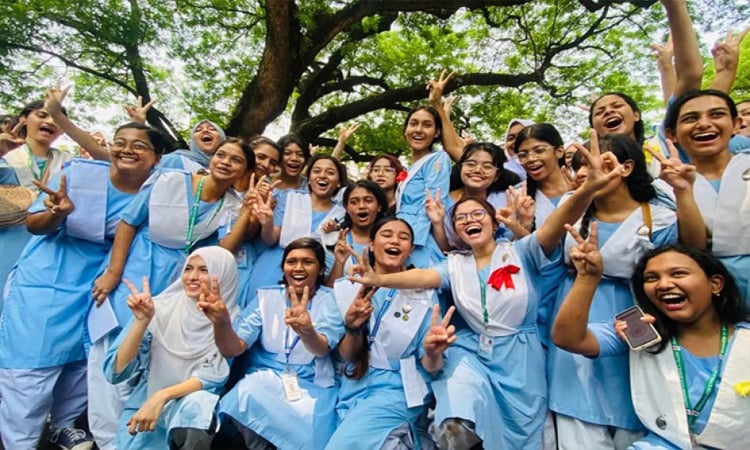
Just over half of the candidates in Bangladesh’s HSC and equivalent examinations passed this year, according to results announced on Saturday. The overall pass rate was 52.12%, leaving 594,113 students unsuccessful as the government prepares a supplementary examination system intended to shorten the wait for another attempt.
Education Minister Dr A N M Ehsanul Hoque Milon announced the results at the Secretariat in Dhaka on 31 October. BSS reported that 646,685 of the 1,240,798 candidates who appeared under the country’s 11 education boards passed. The rate was down from 58.83% last year, a decline of 6.71 percentage points.
The number achieving the highest grade also fell. This year, 40,084 candidates received GPA-5, compared with 69,097 in 2025, according to BSS. That is 29,013 fewer top grades. The results cover the nine general education boards as well as the madrasah and technical education boards.
The minister acknowledged that the outcome was unsatisfactory, bd24live reported. He said the ministry and education boards would work to address the shortcomings and called on teachers and parents to help improve future results. The reports do not establish a single explanation for the nationwide decline, and the lower pass rate alone cannot show how much individual factors contributed.
The institutional picture was also weaker. BSS reported that 293 institutions had no successful candidates, 91 more than last year, while 139 institutions achieved a complete pass rate. Those figures put attention on the uneven results across institutions, alongside the immediate question of what unsuccessful students can do next.
A proposed supplementary examination route could change the usual wait. Under the existing system described by Dhaka Tribune, students who fail subjects normally return for the following year’s examinations. An earlier opportunity could allow them to clear outstanding subjects without losing a full year.
Dhaka Tribune reported that officials discussed the new opportunity at Saturday’s announcement, identifying 422,905 students who had failed in one or two subjects. However, the report also quoted education board officials saying the ministry still had to decide how many failed subjects would qualify. The proposal therefore should not yet be read as a final eligibility notice for every unsuccessful candidate.
The timing also needs care. Professor Syed Akhtaruzzaman, chairman of the Inter-Education Board Coordination Committee and the Dhaka Education Board, told Dhaka Tribune that a one-month period for answer-script re-scrutiny would come first. A supplementary examination schedule would be announced after the re-scrutiny results.
He said a process involving two subjects could be completed within two months, while three or more subjects could require up to three months. Those estimates concern a process that includes examinations, marking and publication of results; they do not provide students with a confirmed examination date.
Applications for re-scrutiny can begin on 1 November, according to the minister’s remarks reported by bd24live. Re-scrutiny and a supplementary examination are separate steps: the former concerns the existing answer scripts, while the latter would give eligible candidates another chance to sit examinations.
For students and families, the next concrete developments are the boards’ re-scrutiny instructions and the ministry’s final supplementary examination rules. Until those are issued, the number of subjects allowed, the application arrangements and the dates for retakes remain matters to be confirmed.